
Resources Library
Articles
Practical guides for turning chart analysis into executable systems, reviewable evidence, and better trading decisions.
Most Read
Start here
- Using Codex or Claude Code With IBKR Chart Data
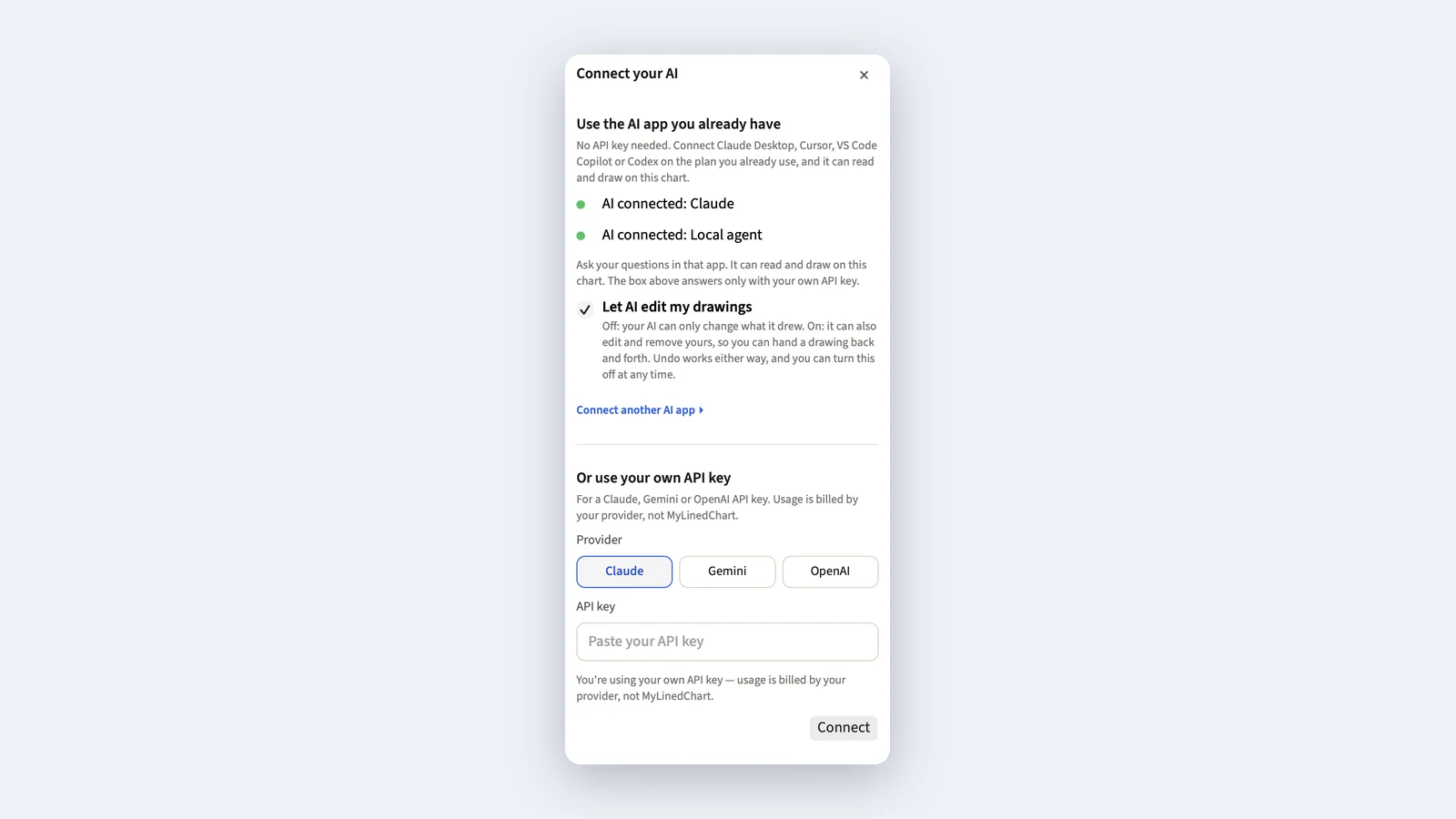
Use Codex or Claude Code with IBKR chart data through a focused IBKR Codex workflow built around structured exports, prompts, field definitions, and human review.
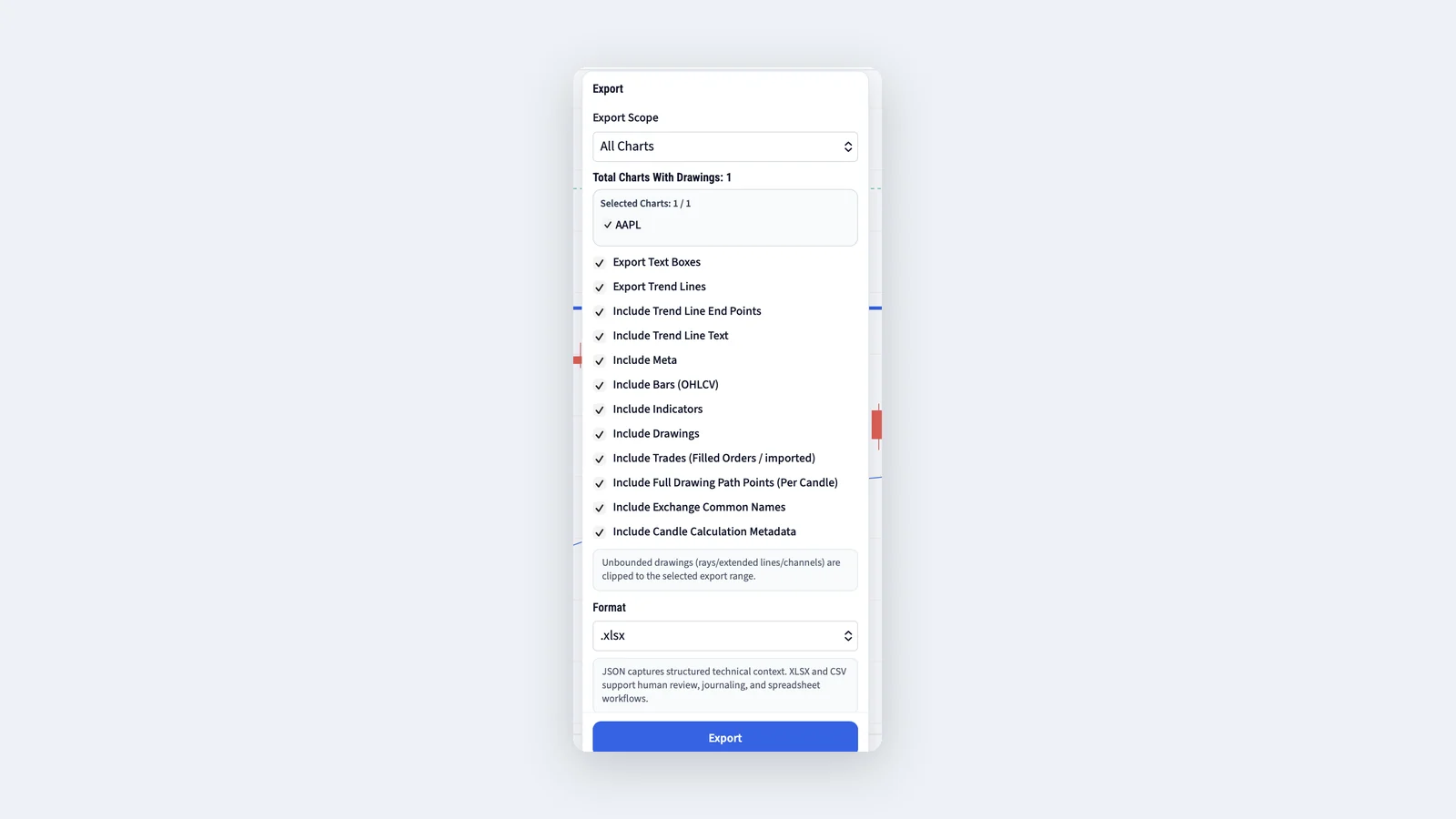
- IBKR vs Alpaca vs Tradier: Costs, Limits, Data Gaps
Compare IBKR vs Alpaca vs Tradier by workflow fit: market access, automation, order handling, data, and review evidence for technical traders.
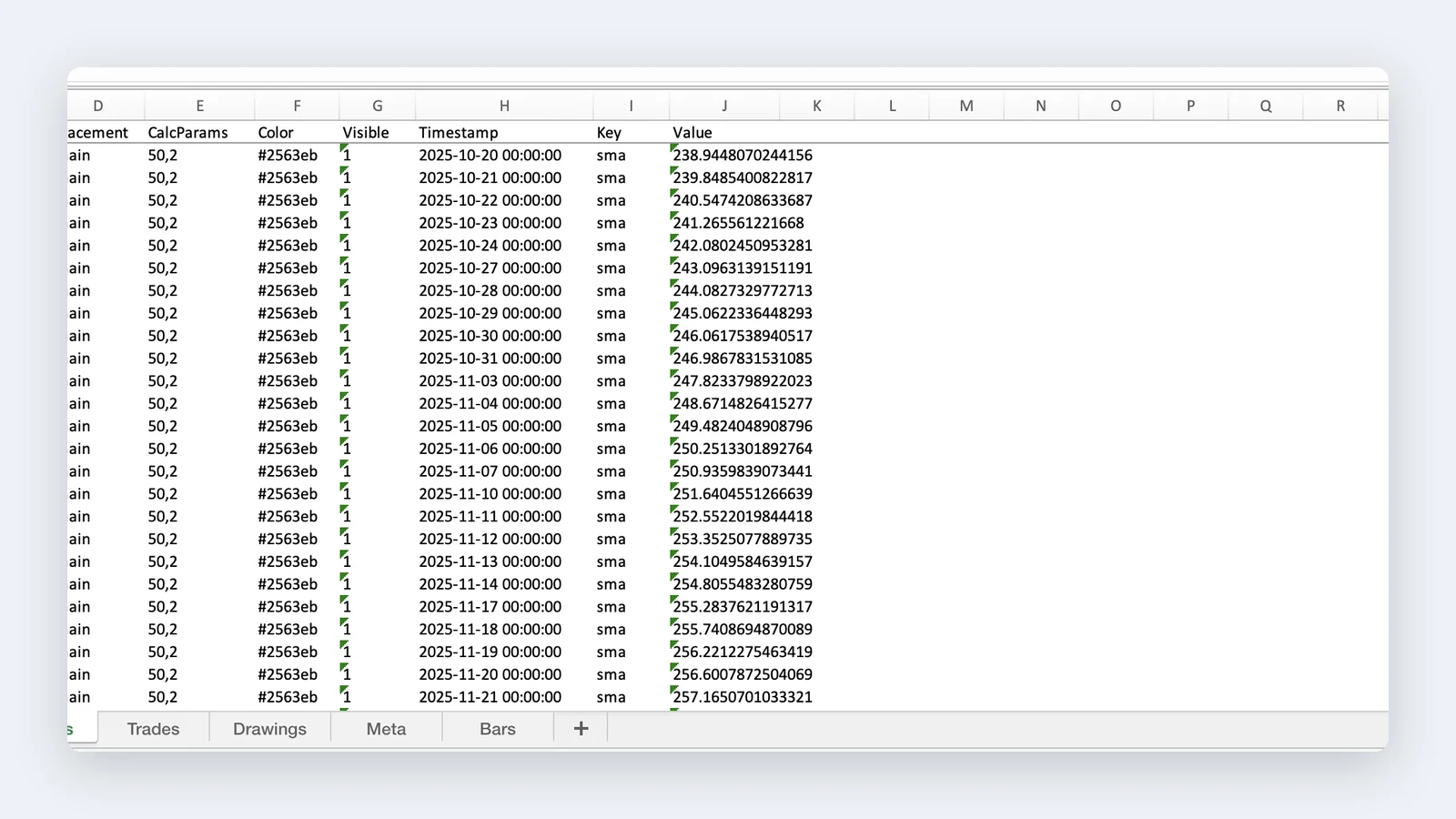
- Export TradingView Chart Data to CSV
TradingView can export price data, but never the analysis you drew on top of it. Here is what the Data Window actually gives you, where the CSV path stops, and a simple structured-export workflow for reviewing your own process over time.
Library Search
All Articles
Search, filter, and sort the full article archive.
All Articles
Browse every MyLinedChart article while filters finish loading.
- No One Can Teach You to Trade. Art School Can’t Make You Picasso Either.
Trading education can give you tools, language, and critique, but it cannot install your judgment. Your edge has to become yours through structured repetition, review, and execution evidence.
- Trading Education Can Give You Tools. It Cannot Give You Your Eye.
Trading education gives you concepts and examples, but your trading eye forms only when repeated decisions are captured, compared, and reviewed against outcome and adherence.
- Your Strategy Is Borrowed Until Your Execution Proves It
A strategy learned from another trader is only borrowed structure until your own execution data proves you can run it consistently under pressure.
- The Market Does Not Care What You Know. It Reveals What You Do Under Pressure.
Day 4 begins with a hard operating standard: knowledge is not the grade. The grade is the action the trader takes when speed, risk, loss, boredom, or fear starts pressing on the plan.
- You Are Not Looking for a Guru. You Are Building a Feedback Loop.
The goal is not finding someone who hands you certainty. The goal is building a feedback loop that shows what works, what leaks, and what needs one controlled upgrade next.
- Screen Time Is Not Experience Until You Review It Correctly
Watching charts for hours does not automatically create trading skill. Experience forms when observations are captured, compared, and converted into better rules.
- A Setup Is Not an Edge Until It Survives Your Weakest Session
A setup that works only when you are calm, rested, and selective is not yet an operating edge. Real edge has to survive pressure, fatigue, speed, and frustration.
- Stop Copying Traders. Start Extracting Your Own Rules.
Copying another trader's conclusions keeps you dependent. Extracting rules from examples helps you build your own decision model and review process.
- The Self-Coached Trader: How Edge Becomes Personal
Edge becomes personal when you build a review process that catches your own drift, updates one rule at a time, and keeps you accountable to evidence.
- Why Your Edge Cannot Be Copied: The Trader Has to Become the System
A copied system can provide structure, but the trader has to become the operating system through constraints, repetition, review, and behavior control.
- The Educator’s Eye Does Not Transfer With the Lesson
A skilled educator can explain what they see on a chart, but the learner still has to build personal judgment through classification, execution, and review.
- Chart Tools Are Training Rails, Not Trading Judgment
Trendlines, levels, indicators, and checklists can structure attention, but they are training rails. Judgment still comes from reviewed decisions.
- Why Trading Concepts Fall Apart on Live Charts
Trading concepts often look clear in lessons and examples, then become unstable when speed, uncertainty, and live risk enter the decision.
- From Borrowed Pattern to Personal Rule: The Education Conversion Loop
A borrowed trading pattern becomes useful only when the trader converts it into a personal rule that can be executed, reviewed, and improved.
- Why New Traders Mistake Recognition for Readiness
Recognizing a setup name is not the same as being ready to trade it. Readiness requires rule clarity, behavior control, and reviewed examples.
- How to Train Your Chart Eye With 20 Reviewed Examples
A focused 20-example review sprint helps traders turn chart education into better classification, clearer rules, and stronger judgment.
- The Day 2 Trading Eye Checklist: Turn Education Into Evidence
Use this Day 2 checklist to convert trading education into chart evidence, reviewed examples, rule cards, and a repeatable feedback loop.
- The Execution Proof Test: Can You Run the Rule When It Gets Uncomfortable?
A strategy becomes real only when the trader can run the rule through boredom, speed, losses, missed entries, and pressure.
- The Three Proof Fields: Rule Validity, Execution Adherence, Review Classification
Use three proof fields to determine whether a trading strategy, the rule language, or the trader's behavior needs improvement.
- From Copied Entry to Owned Playbook
A copied entry becomes an owned playbook only after the trader defines context, trigger, invalidation, exits, review fields, and behavior controls.
- The Strategy Ownership Checklist
Use this checklist to decide whether a borrowed trading strategy is ready to keep, revise, reduce, or discard based on execution evidence.
- Day 3 Strategy Proof Scorecard: Turn Borrowed Ideas Into Execution Evidence
Use the Day 3 scorecard to turn borrowed trading ideas into execution evidence, strategy ownership checks, and one controlled rule upgrade.
- Your Best Analysis Does Not Matter If Entry Behavior Breaks the Plan
The third Day 4 article studies the handoff from chart read to order behavior. A clean analysis still fails if the trader chases, anticipates, hesitates, or clicks without the trigger that made the plan valid.
- The Behavior Audit: Review Trades by Action, Not Opinion
The fourth Day 4 article turns the thesis into an audit. Instead of asking whether the session felt disciplined, it records what the trader actually did and which behavior deserves the next control.
- The Three Behavior Failures That Destroy Good Setups
The sixth Day 4 article protects the setup sample from operator damage. Hesitation, chasing, and size drift can change the system before the market gets a fair test.
- Build a Rule-Following Scorecard Before You Add More Indicators
The seventh Day 4 article forces a better diagnostic question: are the current rules actually being operated? Add information only after rule adherence is visible.
- What Losing Trades Reveal About Your Trading Behavior
The eighth Day 4 article turns losses into operator evidence. A losing trade reveals stop discipline, recovery quality, review honesty, and whether the next decision stays inside the process.
- Day 4 Behavior Checklist: Grade Process Before P&L
The final Day 4 article converts the sequence into a checklist. Use it to grade rule adherence, entry transfer, stop discipline, recovery, shutdown behavior, and one next control before P&L tells the story.
- ASX Trade Journaling Workflow: Preserve Levels, Notes, and Review Context
Build an ASX trade journaling workflow that preserves levels, notes, drawings, labels, invalidation context, and review-ready exports.
- TradingView Drawing Export Limits: A Review Workflow for Australian Traders
Review TradingView drawing export limits and build a workflow that preserves chart notes, labels, levels, drawings, and export-ready review context.
- ASX Market Data and Broker Checklist for Technical Trading Workflows
Use an ASX market-data and broker checklist to evaluate coverage, timing, history, permissions, exports, and workflow fit before building a chart review process.
- IBKR Australia Chart Workflow for Technical Traders
Build an IBKR Australia chart workflow that keeps market data, chart notes, time zones, exports, and review records separate and auditable.
- IBKR Australia vs Alpaca vs Tradier for Technical Traders: Broker API Workflow Fit
Compare IBKR Australia, Alpaca, and Tradier as broker API workflow candidates for Australian technical traders without making a broker recommendation.
- US Market Trading Workflow From Australia: Chart Review, Time Zones, and Exports
Plan a US market trading workflow from Australia with cleaner chart review records, time zone context, export checks, and journal structure.
- TradingView Data Window CSV Export Limits for Australian Traders
Review TradingView Data Window CSV export limits for Australian traders and plan a cleaner workflow for chart notes, levels, labels, and AI-readable review.
- AI-Readable Chart Review Workflow for Australian Technical Traders
Create an AI-readable chart review workflow for Australian technical traders using structured notes, levels, labels, sessions, and export fields.
- Codex Prompt Template for Australian Broker and Chart Data Workflows
Use a Codex prompt template for Australian broker and chart-data workflows that keeps provider limits, chart context, and review boundaries explicit.
- Claude Code Review Workflow for Australian Chart Notes and Broker Data
Use Claude Code to review Australian chart notes and broker-data workflows by checking fields, export assumptions, labels, and provider boundaries.
- Broker API Readiness Checklist for Australian Technical Traders
Use a broker API readiness checklist for Australian technical traders before building automation around market data, chart exports, and review records.
- Structured Chart Journal for ASX and US Trades From Australia
Build a structured chart journal for ASX and US trades from Australia using market, session, levels, labels, notes, exports, and review fields.
- SGX Trade Journaling Workflow: Preserve Levels, Notes, and Review Context
Build an SGX trade journaling workflow that preserves levels, notes, drawings, labels, invalidation context, skipped setups, and review-ready exports.
- SGX Market Data and Broker Checklist for Singapore Technical Traders
Use an SGX market-data and broker checklist to evaluate coverage, timing, entitlements, symbol mapping, exports, and chart workflow fit.
- IBKR Singapore Chart Workflow for SGX and US Market Review
Build an IBKR Singapore chart workflow that separates broker access, market data, SGX and US sessions, chart notes, exports, and review records.
- IBKR Singapore vs Tiger Brokers vs Moomoo: API and Chart Workflow Fit
Compare IBKR Singapore, Tiger Brokers, and Moomoo for API and chart workflow fit by market access, data permissions, exports, controls, and review records.
- TradingView SGX Data Window CSV Export Limits for Singapore Traders
Review TradingView SGX Data Window CSV export limits and plan how to preserve chart notes, levels, labels, sessions, and review context separately.
- TradingView Drawing Export Limits for SGX and US Charts From Singapore
Review TradingView drawing export limits for Singapore traders using SGX and US charts, then preserve notes, labels, levels, and review context.
- US Market Trading Workflow From Singapore: SGT Time Zones, Chart Review, and Exports
Plan a US market trading workflow from Singapore with SGT time-zone fields, session context, chart notes, broker records, exports, and review checks.
- Structured Chart Journal for SGX and US Trades From Singapore
Build a structured chart journal for SGX and US trades from Singapore with market, session, SGT review time, notes, levels, labels, exports, and provider fields.
- Codex Prompt Template for Singapore Broker and Chart Data Workflows
Use a Codex prompt template for Singapore broker and chart-data workflows with SGX, US market, provider, export, and compliance boundaries.
- Broker API Readiness Checklist for Singapore Technical Traders
Use a broker API readiness checklist for Singapore technical traders before building around SGX data, US market access, chart exports, and review records.
- HKEX Trade Journaling Workflow: Preserve Levels, Notes, and HKT Review Context
Build an HKEX trade journaling workflow that preserves levels, notes, drawings, labels, invalidation context, skipped setups, and review-ready exports.
- HKEX Market Data and Broker Checklist for Hong Kong Technical Traders
Use an HKEX market-data and broker checklist to evaluate coverage, timing, entitlements, symbol mapping, exports, and chart workflow fit.
- IBKR Hong Kong Chart Workflow for HKEX and US Market Review
Build an IBKR Hong Kong chart workflow that separates broker access, market data, HKEX and US sessions, chart notes, exports, and review records.
- Futu, Tiger, Webull, Saxo, and IBKR Hong Kong: API and Chart Workflow Fit
Compare Hong Kong broker API and chart workflow fit across IBKR, Futu/Moomoo, Tiger Brokers, Webull, and Saxo status checks without making a broker recommendation.
- TradingView HKEX Data Window CSV Export Limits for Hong Kong Traders
Understand TradingView HKEX data-window CSV export limits and what Hong Kong traders should preserve separately for review workflows.
- TradingView Drawing Export Limits for HKEX and US Charts From Hong Kong
Review TradingView drawing export limits for Hong Kong traders who need HKEX and US chart notes, levels, labels, and review context outside the workspace.
- US Market Trading Workflow From Hong Kong: HKT Chart Review and Exports
Build a US market trading workflow from Hong Kong with HKT review time, US sessions, broker records, chart notes, levels, labels, and exports.
- Structured Chart Journal for HKEX, Stock Connect, and US Trades From Hong Kong
Build a structured chart journal for HKEX, Stock Connect-related, and US trades from Hong Kong with market, session, HKT review time, notes, levels, labels, exports, and provider fields.
- Codex Prompt Template for Hong Kong Broker and Chart Data Workflows
Use a Codex prompt template for Hong Kong broker and chart-data workflows with HKEX, US market, provider, export, and compliance boundaries.
- Broker API Readiness Checklist for Hong Kong Technical Traders
Use a broker API readiness checklist for Hong Kong technical traders before building around HKEX data, US market access, chart exports, and review records.
- IBKR vs Rakuten, SBI & Monex: Which Setup Fits an AI-Readable Chart-Review Workflow
Compare IBKR, Rakuten Securities, SBI Securities, and Monex on chart review, export, and AI-readable workflow fit for Japanese technical traders, not fees or account promotions.
- Reviewing US Markets Overnight From Japan: The JST Chart-Review Workflow
Build a workflow for reviewing US market chart activity that runs overnight in JST, so TSE and overnight-US notes survive into one morning review.
- IBKR vs Hargreaves Lansdown, IG & Trading 212: Chart Review & Export Fit
Compare IBKR, Hargreaves Lansdown, IG, and Trading 212 on chart review, export, and AI-readable workflow fit for UK technical traders, not fees or account promotions.
- The Afternoon Overlap: Charting LSE and US Markets While Both Are Open
Build a chart-review workflow for the two-hour window when LSE and US markets trade simultaneously, instead of treating it like an overnight scheduling gap.
- IBKR vs Kiwoom vs Mirae Asset vs Toss Securities: Chart and API Workflow Fit for Korean Traders
Compare IBKR, Kiwoom, Mirae Asset, and Toss Securities on chart review, API access, and export workflow fit for Korean traders, not account fees or promotions.
- US Market Trading Workflow From Korea: Overnight KST Chart Review and Exports
Build a workflow for reviewing US market chart activity that runs overnight in KST, so notes, levels, and drawings survive to the next-day review.
- KOSPI/KOSDAQ Market Data and Broker Checklist for Korean Technical Traders
A provider-neutral checklist for confirming KOSPI and KOSDAQ market-data access, entitlements, and broker API readiness before building a chart workflow.
- Structured Chart Journal for KOSPI, KOSDAQ, and US Trades From Korea
Build a structured chart journal that covers KOSPI, KOSDAQ, and US trades from Korea in one consistent format instead of fragmented screenshots.
- Korean Retail Traders (개미): Decide Better and Learn From Your Own Trades
A structured review habit for Korean retail traders (개미) that turns each KOSPI, KOSDAQ, or US trade into a lesson instead of a repeated pattern.
- IBKR vs Zerodha, Groww & Upstox: Chart-Review & Export Workflow Fit
Compare IBKR, Zerodha, Groww, and Upstox on chart review, export, and AI-readable workflow fit for Indian technical traders, not fees or account promotions.
- Reviewing US Markets Overnight From India: The IST Chart-Review Workflow
Build a workflow for reviewing US market chart activity that runs overnight in IST, so notes, levels, and drawings survive to the next-morning review.
- IBKR vs DEGIRO, Trade Republic & Saxo: Chart-Review & Export Fit
Compare IBKR, DEGIRO, Trade Republic, and Saxo on chart review, export, and AI-readable workflow fit for European technical traders, not fees or account promotions.
- Charting Across European Exchanges: XETRA, Euronext, and One Structured Record
Keep chart review coherent when a European watchlist spans XETRA and Euronext's multiple national markets, instead of fragmenting notes and levels by exchange.
- IBKR vs Questrade, Wealthsimple & TD Direct: Chart-Review & Export Fit
Compare IBKR, Questrade, Wealthsimple, and TD Direct Investing on chart review, export, and AI-readable workflow fit for Canadian technical traders, not fees or account promotions.
- TSX and US in One Session: A Same-Timezone Chart-Review Workflow
Build a chart-review workflow for TSX and US names that trade the same Eastern Time session, so notes and levels stay coherent across cross-listed and dual-currency setups.
- IBKR vs Swissquote, Saxo & PostFinance: Chart-Review & Export Fit
Compare IBKR, Swissquote, Saxo, and PostFinance on chart review, export, and AI-readable workflow fit for Swiss technical traders, not fees or account promotions.
- A Structured Review Record for SIX/SMI Blue-Chip Setups
Build a precise, reviewable chart record for SMI blue-chip setups, where a small, concentrated index rewards discipline over volume of trade ideas.
- How to Turn Chart Notes Into Substack Articles Without Starting From Scratch
Use MyLinedChart to turn marked-up charts, notes, levels, and review context into a cleaner Substack article workflow.
- Why Trading Screenshots Alone Make Weak Substack Posts
Screenshots show what a chart looked like, but they often miss the reasoning, levels, timing, invalidation, and review context readers need.
- The Trader's Substack Workflow: From Chart Setup to Reader-Friendly Lesson
Build a practical Substack workflow that turns one chart setup into context, decision, review, lesson, and reader takeaway.
- How to Build a Weekly Trading Newsletter From Your Chart Review Process
Turn weekly chart review into a repeatable Substack newsletter format with setup examples, mistakes, rule upgrades, and watchlist lessons.
- Chart Annotation to Article Outline: A Simple Publishing System for Traders
Use a simple publishing system that turns chart annotations into headlines, theses, key observations, lessons, and Substack drafts.
- Using AI With MyLinedChart Exports to Draft Better Trading Articles
Use AI as a drafting assistant for trading articles by giving it structured MyLinedChart context instead of vague screenshots or unsupported prompts.
- How Coaches and Educators Can Turn Chart Reviews Into Substack Content
Trading coaches and educators can turn chart reviews into useful Substack content by preserving examples, lessons, and anonymized review context.
- The Trading Content Flywheel: Review Better, Write Better, Teach Better
A better chart review process can create a content flywheel where traders review better, write clearer posts, and teach more useful lessons.
- Give Your Readers the Data, Not Just a Screenshot: Exporting Your Chart Analysis for Posts and Videos
Finance writers, YouTubers, and newsletter authors: your charts do not have to stay screenshots. Export your drawings, levels, and notes as XLSX, CSV, or JSON so your audience can actually use the levels you call.
- SpotGamma Levels on Your IBKR Chart: Import Them with AI
You pay for SpotGamma, but its key levels live in the dashboard and its TradingView or NinjaTrader uploads, not on your IBKR chart. Here is how to bring them onto IBKR with MyLinedChart and AI.
- MenthorQ Levels on Your IBKR Chart: Import Them with AI
MenthorQ pushes its gamma levels into Quantower, TrendSpider, and a handful of other platforms through an API key, but not IBKR. Here is how to bring them onto your IBKR chart with MyLinedChart and AI.
- Unusual Whales GEX Levels on Your IBKR Chart: Import Them with AI
Unusual Whales shows GEX and Greek-exposure levels in its dashboard, with an API on the upper tier, but neither draws on a native IBKR chart. Here is how to bring them onto IBKR with MyLinedChart and AI.
- How to Use MyLinedChart to Build a DCF Thesis Map
Use MyLinedChart as the thesis and evidence layer around a DCF model so valuation assumptions, fair value zones, catalysts, and review notes stay connected to price.
- DCF Models Are Only Useful If You Track the Assumptions
A DCF model gets weaker when revenue, margin, discount rate, terminal value, and catalyst assumptions are not tracked after the first valuation.
- Price vs Intrinsic Value: How to Track DCF Upside on a Chart
Track DCF upside on a chart by mapping fair value ranges, margin of safety, current price, and thesis review zones in one visible workflow.
- DCF Scenario Planning: Bear, Base, and Bull Case Levels
Use bear, base, and bull case DCF levels to organize uncertainty around valuation, price, catalysts, and thesis review.
- From 10-K Notes to Chart Notes: Investor Workflow
Turn 10-K research notes into chart notes that connect business drivers, valuation assumptions, risks, and catalysts to price.
- DCF Exit Discipline: When Price Reaches Fair Value
Use DCF exit discipline to decide what to do when price reaches fair value, including hold, trim, exit, or update the thesis with new evidence.
- Fundamental Trader Journal: Valuation, Catalyst, Thesis
Build a fundamental trader journal that tracks valuation, catalyst evidence, price context, thesis updates, and decision quality over time.
- What to Prepare Before a Trading Workflow Consulting Call
Prepare for a trading workflow consulting call with the right chart examples, exports, broker context, journal fields, dashboard goals, and boundaries.
- Trading Automation Consulting vs. Integration Consulting
Understand the difference between trading automation consulting and integration consulting before asking someone to connect charts, broker data, journals, dashboards, or AI tools.
- TradingView to Broker Workflow Consulting: Webhooks, Logs, and Human Review
Plan a TradingView-to-broker workflow around webhook logs, duplicate checks, broker responses, journal rows, and human review before expanding automation.
- IBKR Workflow Consulting: Chart Data, Trade History, Journals, and Dashboards
Plan IBKR workflow consulting around chart context, trade history, exports, journal fields, dashboard metrics, and implementation checks.
- How to Actually Use AI to Trade Better, a Practical Claude Code & Codex Workflow
Stop pasting screenshots and vague prompts into AI. Here is the exact workflow for using Claude Code or Codex with your real chart data to review your process, build journals, and draft indicators, one reviewable job at a time, never trade decisions.
- Trading Journal Automation Consulting: From Notes and Broker Exports to a Review Process
Plan trading journal automation consulting around chart notes, broker exports, setup tags, mistake tags, skipped trades, dashboard fields, and review cadence.
- Broker Data Reconciliation Consulting: Why Your Chart, Broker, and Journal Numbers Do Not Match
Use broker data reconciliation consulting to inspect mismatches between chart data, broker history, journal rows, dashboard metrics, timestamps, sessions, and execution records.
- Trading Dashboard Consulting: Turning Exports and Broker Data Into Useful Review Metrics
Plan trading dashboard consulting around chart exports, broker history, journal fields, review metrics, definitions, filters, QA checks, and human-readable summaries.
- Trading Automation Readiness Audit: What to Check Before Any Live Order Automation
Use a trading automation readiness audit to check logs, source data, broker permissions, duplicate signals, human review, rollback plans, and QA before live order automation.
- What Does IBKR's Certified Claude and ChatGPT Connector Actually See, and What Is the Chart Context Gap?
IBKR's certified MCP connector gives Claude and ChatGPT access to your account, positions, and market data, but not your chart drawings, annotated levels, or TA state. Here is what that gap means for technical traders.
- How to Export a TC2000 Watchlist or List to CSV, and the Column Values Limitation Explained
TC2000 lets you export a list of symbols to CSV, but the computed PCF column values are not included. Here is what ships and what does not, and how traders work around it.
- How to Export NinjaTrader Chart Data, OHLCV and Indicator Values to CSV
NinjaTrader exports OHLCV bar data through the Data Manager in semicolon-delimited CSV. Indicator values are not in that export, getting them out requires a NinjaScript file-write approach.
- Bookmap Alert Export: What You Get and What's Missing
Bookmap's native export is primarily visual. Alert notifications can be logged to external destinations, but structured CSV export of alert events and indicator readings with timestamps is not built into the platform, here is what is available and what is not.
- Does TrendSpider Export Raw Historical Price Data? The Backtest-Only Reality
TrendSpider does not offer a native raw OHLCV bulk export. The price data accessible through its export tools comes from strategy backtest results, entry and exit prices at signal points, not full bar-by-bar history.
- What Is Trade Replay? The Definitive Guide to Chart Replay Practice for Technical Traders
Trade replay, also called chart replay or market replay, lets technical traders replay historical price data bar-by-bar to practice entries, exits, and decision-making without live risk. This definitive guide covers how replay works, the platforms that support it, how to structure sessions for skill transfer, and when replay practice translates to live performance.
- IBKR vs Moomoo vs Tiger Brokers: API and Market Data for Technical Traders with Global Accounts
IBKR, Moomoo, and Tiger Brokers serve global retail traders but differ dramatically in API depth, market data coverage, and developer support. Here is the comparison for technical traders who need API access alongside multi-market chart workflows.
- Schwab Trader API Cost vs IBKR and Alpaca: What Retail Technical Traders Actually Pay
Schwab Trader API is free to use with a Schwab account. IBKR's API is also free but market data subscriptions add monthly cost. Alpaca has a free data tier and a paid SIP tier. Here is what each broker's API actually costs for retail technical traders.
- Why Confirmation-First Traders Often Outperform First-Touch Traders
Use structured confirmation rules before execution instead of reacting on first touch.
- Mean Reversion Trading With Structured Level History
Build a better mean reversion process by tracking tested levels and reaction quality.
- From Paper Trading to Live With Less Execution Friction
Transition from paper to live by standardizing setup capture and reducing manual chart overhead.
- Macro Traders: Get the Key Levels Without Learning Technical Analysis
You trade the macro thesis, not the chart. But before you put the trade on, you still want a read on support, resistance, and the trend. Here is how to get that basic technical picture with AI, without becoming a chartist.
- High-Net-Worth Investors and Structured Chart Journaling
Create a tighter decision trail by pairing thesis notes with exported technical context.
- How to Turn Chart Drawings Into Automation-Ready Data
A practical framework for moving from visual chart notes to machine-readable process inputs.
- MyLinedChart Video Tutorial: Export Drawing Data Step by Step
A full walkthrough tutorial for exporting trend lines, levels, and note annotations as reusable data.
- Build a Better Pre-Market Routine With Exportable Levels
Use a repeatable level-marking process so daily prep becomes faster and higher quality.
- The Real Difference Between Chart Markup and Trade Readiness
Why drawing lines is not enough, and how structured context helps decision readiness.
- A Better Alternative to TradingView Bulk Watchlist Export
A cleaner path for traders who need more than raw watchlist chart exports.
- Export Chart Data With Notes for Real Trade Journals
Build review-ready journals by exporting annotated context, not only prices.
- IBKR Chart Workflow for Cleaner Data Routines
A practical guide for turning IBKR chart context into repeatable data, review, and provider routines.
- TradingView to MyLinedChart Transition Guide
A practical migration approach for teams that want reusable drawing exports by default.
- MyLinedChart vs TradingView Lightweight Charts: Start Charting Today, or Start Building Today?
Lightweight Charts is open source, but MyLinedChart is ready to use now with export/import built in.
- MyLinedChart vs TradingView Advanced Charts: Start Today, or Chance Rejection?
TradingView Advanced Charts is a library you apply for. MyLinedChart is a finished app that IBKR traders can open and use today.
- KLineChart in Production: What We Added
KLineChart is the open-source charting library MyLinedChart renders with. What the library gives you, what it deliberately leaves out, and what a finished product has to supply.
- Stop DOM Hacking for Drawing Data. Start Using MyLinedChart.
A practical explanation of why DOM extraction routines break and what a native drawing-export process looks like instead.
- A TradingView Drawing Export Alternative That Keeps Context
Why traders switch when they need structured exports of drawings, notes, indicators, and OHLCV in XLSX and CSV.
- How to Export Chart Drawings to XLSX and CSV for Real Workflows
A practical chart-to-dataset workflow for exporting annotations as reusable XLSX and CSV records.
- Chart Annotation Export for Trading Journals in XLSX and CSV
Move from screenshot-based journaling to structured annotation records in XLSX and CSV.
- Export TrendSpider Drawings to CSV: What Actually Works
TrendSpider supports CSV workflows, but complete export coverage for drawings, notes, indicators, and OHLCV is a separate question.
- Bulk Chart Snapshots vs Bulk Drawing Data Export: Know the Difference
Sharing many charts at once is useful, but image snapshots are not structured exports of drawings, notes, indicators, and OHLCV.
- Marking Four Charts in One Pass: What a Multi-Symbol Export Shows That One Chart Cannot
One session, four symbols, one file. The question a multi-symbol export answers is the one a single chart cannot: was that move confirmed, or did it happen alone?
- One Chart, One Setup: Marking a Level and Waiting for It
The simplest session there is. One symbol, one level, one note about what would make you act, and a file that lets you check afterwards whether the level did anything.
- Draw First, Think Later: Naming Your Markup After the Fact
Plenty of chart work happens before the reasoning arrives. That is fine. The export is the deadline, not the drawing.
- One Rule, Three Ways to Trade It: From an Exported Level to an Order
A written rule is not a trade. Here is the same rule, taken from a real export, reaching the market three ways: by eye, as code you write, and handed to an AI agent.
- The MyLinedChart Loop: Mark Up, Name It, Export, Then Reopen It Next Session
A working session in MyLinedChart, start to finish, using a real exported file. The habit that makes the difference is not the drawing, it is naming the drawing before you export it.
- TradingView vs TrendSpider vs MyLinedChart: Structured Chart Exports for Real Trading Processes
A systems-first comparison of TradingView, TrendSpider, and MyLinedChart for traders building executable feedback loops.
- TrendSpider vs MyLinedChart: Drawing Data Exportability Comparison
Compare TrendSpider and MyLinedChart by operating layer: signal automation versus trader-intelligence feedback loop execution.
- Chart Drawing Data Model for CSV/XLSX Analysis
A practical schema for trendlines, zones, notes, and setup metadata that supports journals, reviews, and backtesting workflows.
- How to Convert thinkorswim Chart Annotations to CSV/XLSX
A practical method to move thinkorswim annotation workflows into structured CSV/XLSX records for coaching and review.
- Can You Export Drawings from StockCharts ACP
How StockCharts ACP users can evaluate drawing-export workflows when they need structured review datasets.
- Export TC2000 Chart Notes to CSV/XLSX (Structured)
How to convert TC2000 chart-note routines into structured CSV/XLSX datasets that are usable in repeatable reviews.
- Can You Export Drawings from NinjaTrader
A practical evaluation framework for NinjaTrader users who need structured export outputs beyond chart visuals.
- MetaTrader 5 Technical Objects to CSV/XLSX: Practical Workflow
A practical workflow to convert MT5 technical objects into structured CSV/XLSX data for review, journaling, and audits.
- Can You Export Drawings from Sierra Chart
How Sierra Chart users can test whether drawing exports are complete enough for repeatable review workflows.
- Can You Export Drawings from eSignal Advanced Charts
A practical framework for eSignal users who need structured export workflows for repeatable review operations.
- Koyfin Chart Annotations to CSV/XLSX for Research Workflows
A research-oriented workflow for moving Koyfin annotation context into structured CSV/XLSX exports.
- Chart Annotation Schema Template for CSV/XLSX (Free Starter)
A practical CSV/XLSX schema template for chart annotations, journals, and review pipelines.
- MyLinedChart vs Major Charting Platforms: Drawing Data Exportability
This comparison focuses on which platform stack actually improves trader decision systems over time.
- EODHD vs Charting Platforms: Market Data vs Drawing Data
A clear role split: EODHD for market data delivery, chart platforms for annotations, and MyLinedChart for structured export outputs.
- EODHD to CSV/XLSX for Trading Journals: What You Still Need
A journal-focused process that combines EODHD market data with structured annotation exports for decision-quality reviews.
- EODHD Plus MyLinedChart Stack: Data Feed and Drawing Exportability
A stack blueprint: EODHD for feed reliability and MyLinedChart for structured chart exports that survive review and automation.
- Backtesting with EODHD Data and Annotation Context
Backtesting becomes more realistic when EODHD bars are paired with exported annotation context from real chart decisions.
- Switch Data Providers to EODHD Without Losing Chart Context
A migration workflow for switching to EODHD while keeping historical chart decision context intact and export-ready.
- Using EODHD Without Manual Chart-Note Rework
How to replace manual chart-note rework by pairing EODHD feeds with structured exports that preserve full decision context.
- Can You Export Drawings from Robinhood Legend? What Traders Need in 2026
Robinhood Legend gives you modern charting and drawing tools, but teams still need a structured export layer when they want reusable annotation records.
- Can You Export Drawings from tastytrade? What Actually Transfers in 2026
tastytrade offers charting and drawing capabilities, but serious review workflows still require an exportable annotation dataset outside the chart view.
- How MyLinedChart Supports a More Structured Coaching Process
Use MyLinedChart exports to keep coaching sessions grounded in full chart and annotation context.
- Building Better Review Habits With MyLinedChart Exports
Create repeatable review habits by exporting chart context directly from the same workflow used for analysis.
- MyLinedChart for Coach-Friendly Trade Reviews Without Extra Admin Work
Support coaching reviews with export-ready chart context while keeping prep time low.
- Supporting Pre-Trade and Post-Trade Reflection With MyLinedChart
Preserve full context across pre-trade and post-trade reviews to reduce hindsight drift.
- Using MyLinedChart to Keep Coaching Reviews Focused on Decision Context
Use MyLinedChart exports to center review sessions on decision quality, not just chart outcomes.
- The Weekly Review That Actually Teaches: Chart Context Coaches and Traders Can Reuse
Screenshot reviews reset to zero every week. Here is a weekly review workflow where the trader's real chart context, drawings, levels, notes, and the reasoning behind each trade, becomes reusable structured data a coach can compare week over week.
- How MyLinedChart Helps Preserve Setup Logic Between Coaching Sessions
Keep setup reasoning intact between sessions by exporting structure, notes, and indicator context together.
- From Chart Session to Review Session: A MyLinedChart Export Workflow
Move from active charting to review quickly by reusing one structured export workflow.
- Why Structured Chart Context Improves Coaching Consistency in MyLinedChart
Consistent context fields create more reliable coaching sessions and cleaner process tracking.
- How MyLinedChart Reduces Review Drift Across Multi-Symbol Coaching
Keep multi-symbol reviews coherent by preserving consistent context across all charts.
- Using MyLinedChart Exports to Compare Planned vs Executed Trade Context
Compare setup intent against execution outcomes with one preserved context workflow.
- MyLinedChart as a Review Layer for Coaching, Journaling, and Process Tracking
Use MyLinedChart as the context layer that supports coaching, journaling, and ongoing process analysis.
- Turning MyLinedChart Annotations Into Repeatable Coaching Checkpoints
Turn annotation context into consistent checkpoints that improve coaching rhythm and clarity.
- Keeping Indicator, Drawing, and Note Context Together for Better Coaching Reviews
Use MyLinedChart to preserve indicator, drawing, and note context together for clearer review sessions.
- A Low-Friction MyLinedChart Process for Ongoing Trader Development Reviews
Support ongoing development reviews with a lightweight export workflow that preserves full context.
- Missed Fill vs Bad Signal: A Post-Trade Framework for Semi-Auto Systems
Use a two-stage audit to avoid fixing the wrong layer in hybrid trading workflows.
- Prop Challenge Rule-Breach Autopsies: The 5 Patterns That Blow Accounts
Analyze high-frequency breach patterns in funded challenges and map each to a hard control.
- Prop-Firm Consistency Logs: Tracking Rule Adherence, Not Just P&L
Track compliance metrics daily so challenge performance is durable under rule constraints.
- Drawdown Recovery Drills: A Structured Replay Routine for Emotional Control
Train disciplined recovery behavior in replay before risking live capital during drawdown pressure.
- Execution Quality by Market Regime: When Your Fill Logic Stops Working
Audit fill quality by regime so execution logic adapts before slippage and missed fills erode edge.
- Rule-Break Probability Scoring: Predicting Bad Trades Before They Trigger
Score pre-trade rule-break risk using context signals so low-discipline entries are filtered before execution.
- Intraday Drawdown Containment: A Layered Risk-Lock Framework
Contain intraday drawdowns with layered locks that tighten risk as behavior and losses deteriorate.
- The Re-Entry Decision Tree: When to Resume Trading After a Hard Stop
Use a structured re-entry tree to decide whether to stand down, sim trade, or resume reduced live risk.
- Coach-Led Time-of-Day Audits: Building Client Risk Windows From Trade Logs
Use coaching audits to convert client trade logs into actionable time-of-day risk and opportunity windows.
- Coaching With Breach Maps: Turn Rule Violations Into Weekly Correction Plans
Map recurring violations into weekly correction plans so coaching sessions produce measurable behavior change.
- Replay-Based Coaching Sprints: A 14-Day Protocol to Fix One Recurring Mistake
Run short replay coaching sprints that target one recurring error until behavior stabilizes.
- Trader Accountability Dashboards: What Coaches Should Track Beyond P&L
Build accountability dashboards with adherence and behavior metrics so coaching is measured by process quality, not outcome variance.
- Pre-Session Coaching Checklists: Align Setup Quality Before Live Execution
Use pre-session coaching checklists to improve setup quality and reduce impulsive low-conviction entries.
- Post-Loss Coaching Protocols: Helping Traders Recover Without Revenge Behavior
Apply post-loss protocols that stabilize trader behavior and reduce emotional re-entry mistakes.
- Multi-Client Pattern Libraries: How Coaches Reuse Failure Playbooks at Scale
Build reusable pattern libraries so coaching teams can apply proven correction playbooks across clients.
- Execution Debrief Templates for Coaches: Separate Signal Errors From Process Errors
Use execution debrief templates so coaching sessions distinguish setup quality issues from execution-quality issues.
- Prop Challenge Coaching Blueprint: Train Rule Adherence for Funded Accounts
Use a prop-focused coaching blueprint that prioritizes rule adherence, loss-limit discipline, and survivability.
- Coaching Progress Milestones: Measuring Behavioral Gains at 30, 60, and 90 Days
Track coaching progress with milestone metrics tied to adherence, decision quality, and drawdown control.
- Can You Export TradingView Drawings to Excel or CSV?
Exporting chart visuals is not the same as exporting drawing context. Use MyLinedChart structured exports for reusable workflow data.
- Export TradingView Chart Data to CSV
TradingView can export price data, but never the analysis you drew on top of it. Here is what the Data Window actually gives you, where the CSV path stops, and a simple structured-export workflow for reviewing your own process over time.
- How to Back Up Trading Drawings So You Don’t Lose Levels After Edits or Updates
Protect your chart decision memory with structured backup checkpoints that can be restored quickly.
- Does TradingView Have a Drawings API? A Reality Check
Builders need reusable drawing datasets. MyLinedChart provides a practical export layer for Python, Sheets, and database workflows.
- How to Share Chart Drawings Across Accounts and Teammates Without Redrawing Everything
Use one standardized annotation packet so coaches, analysts, and traders can reuse context without rebuild work.
- Why Drawings on Indicator Panes Don’t Sync (and How to Preserve Them Anyway)
Pane sync behavior can drift. MyLinedChart exports keep setup context stable across sessions and reviews.
- Technical Analysis Replay Workflow: Turn One Losing Setup Into a Repeatable Improvement Loop
Use one structured replay cycle to turn a losing setup into measurable execution improvements.
- Pre-Market Technical Analysis Checklist: Export-Ready Levels, Zones, and Scenario Tags
Build a pre-market routine that creates executable scenarios instead of vague chart markup.
- False Breakout Detection: How Technical Traders Can Tag Failed Breaks and Retests Systematically
Use objective breakout and retest tags to reduce trap entries and improve filtering quality.
- VWAP Reclaim vs Rejection Setups: How to Capture Entry Context for Post-Trade Review
Separate VWAP reclaim and rejection trades into distinct review tracks to improve setup expectancy analysis.
- RSI and MACD Divergence Logging: A Repeatable Export Workflow for Technical Traders
Log divergence with structure context so signals become testable instead of hindsight narratives.
- Can You Export Support and Resistance Levels to CSV for Multi-Symbol Technical Analysis?
Yes, when levels are stored as structured hypotheses with lifecycle and interaction fields.
- TradingView Multi-Timeframe Replay: How to Backtest 1m/5m/15m Without Context Drift
Use one replay driver timeframe with enforced higher-timeframe checkpoints to prevent context drift.
- TradingView Replay Trade Log Workflow: Exporting Every Decision Without Manual Spreadsheet Pain
Use a fixed replay log schema to capture every decision consistently and reduce review friction.
- Indicator Values Missing in CSV? A Technical Trader’s Guide to Export-Safe Pine Outputs
Design indicator outputs for export reliability so CSV datasets remain complete and analysis-ready.
- From Scanner Hit to Executable Setup: A Structured Handoff Workflow for TrendSpider and TradingView Users
Turn scanner alerts into high-quality setups with a stage-gated handoff process.
- Anchored VWAP Workflow Audit: Where to Anchor, What to Track, and How to Review Outcomes
Standardize anchor selection and audit outcomes by anchor class to improve anchored VWAP consistency.
- False Confluence Problem: How to Score Multi-Signal Setups (VWAP, RSI, MACD, Structure) Before Entry
Use weighted setup scoring to avoid false confluence and improve pre-entry signal quality.
- TradingView vs TrendSpider vs MyLinedChart: Which One Strengthens Your Edge Week After Week?
Compare TradingView, TrendSpider, and MyLinedChart by one standard that matters: which platform setup strengthens your edge week after week.
- Edge Scorecard: 12 Metrics to Prove Your Trading System Is Actually Improving
P&L alone hides process decay. Use a 12-metric scorecard to track adherence, drift, and behavioral quality improvements.
- How to Legally Display IBKR Market Data Without Becoming a Data Vendor
The rule that decides your whole architecture: the moment market data flows through infrastructure you operate, exchanges treat you as a redistributor. Here is how to avoid that.
- The IBKR Market-Data License Costs Nobody Warns Builders About
The redistribution path is not just paperwork, it is real money and a scale commitment. Here are the cost realities we found evaluating a hosted IBKR product.
- Why Your IBKR Trading App Should Be Local, Not Cloud
For most builders, local is not a limitation, it is the only compliant-by-design way to show IBKR data without buying into the exchange-vendor regime.
- Build Your Own IBKR Tool, or Use One? A Cost and Compliance Checklist
Before you build on IBKR, run this checklist. It usually clarifies whether building, adopting an existing local tool, or getting help is the right call.
- Draw IBKR Support and Resistance With Claude, via MCP
Connect Claude to your local MyLinedChart IBKR session and have it draw support, resistance, and trend lines on your live chart, anchored to real prices, confirmed by you.
- Custom Indicators on Your IBKR Chart, Described in Natural Language
Beyond RSI and MACD: describe an indicator in plain language and have your AI build it as a sandboxed formula that renders on your live IBKR chart, no Pine Script, no code.
- Your Edge Starts With You: How Traders Turn Good Reads Into Repeatable Results
Most traders do not fail because they cannot read charts. They fail because they cannot repeat their best decisions under pressure. This guide shows how to close that gap with a practical trader edge loop.
- TradingView CSV Export Limit: Why 3-Minute Data Stops and What to Do for Consistent Backtests
TradingView CSV export limits often break low-timeframe research. This guide shows how to standardize collection, remove merge chaos, and turn fragmented exports into a repeatable process that improves setup testing quality week after week.
- TradingView Strategy CSV: Does It Include Original SL/TP, Exit Reason, and Decision Context?
Many traders assume strategy CSV exports fully preserve original SL/TP and exit context. This guide explains why outcome logs are not enough and how to capture decision-quality data for real process optimization.
- TradingView Drawings vs Notes vs Memory: Mid-Trade Workflow for Repeatable Execution Quality
Splitting analysis across drawings, notes, and memory creates state drift that weakens execution quality. This guide shows how to unify decision state so chart insight translates into consistent behavior and stronger weekly reviews.
- VWAP Retest vs First-Break: Why the Retest Entry Wins
VWAP traders often lose edge by chasing first breaks with weak invalidation. This guide shows how retest execution improves location, risk efficiency, and weekly review quality without sacrificing opportunity flow.
- Your Edge Starts With You, but the Data Layer Decides Whether It Actually Compounds
Most traders have enough market insight but weak process continuity. This article shows how a structured data layer closes the analysis-execution-review gap so improvements survive pressure and compound over time.
- The Challenge Pass Loop: A 30-Day System for First-Attempt Pass Probability
A 30-day operating loop for Topstep-style and SMB-style evaluations that improves rule compliance and first-attempt pass probability.
- Daily Loss-Limit Defense Loop: Preventing Auto-Fail Days in Evaluations
A rule-enforcement loop designed to prevent daily max-loss breaches in funded-account evaluations.
- Trailing Drawdown Pass Loop: Protecting Thresholds While Building P&L
A trailing-drawdown-aware operating loop for funded challenges that balances growth with threshold protection.
- Consistency-Rule Pass Loop: Eliminating “One Big Day” Failure Patterns
A consistency-engineering loop that reduces over-concentrated P&L behavior and improves evaluation pass reliability.
- Eval Session Planning Loop: Pre-Market Structure That Reduces Rule Breaches
A pre-market planning loop that lowers funded-evaluation rule breaches by converting analysis into session-level operating constraints.
- Challenge Breach Recovery Loop: 48-Hour Reset Protocol Before Next Attempt
A 48-hour breach-recovery loop that prevents immediate repeat failures after funded-evaluation rule violations.
- Signal-to-Entry Pass Loop: Turning Alerts into Rule-Compliant Executions
A conversion loop for turning high-volume signals into evaluation-safe entries with funded-account rule compliance.
- Challenge Selection Loop: Matching Firm Rule Geometry to Trader Behavior
A selection loop that maps trader behavior to funded-firm rule structures so candidates choose challenges they are more likely to pass.
- Max-Size Escalation Loop: How to Scale During Eval Without Blowing Limits
A size-escalation loop that helps funded-account candidates grow efficiently without violating drawdown and daily-loss constraints.
- Pass Readiness Scorecard Loop: 12 Metrics Before You Start Any Challenge
A pre-challenge readiness loop with 12 metrics that predict funded-evaluation pass probability before live attempts begin.
- Funded Longevity Loop: The First 60 Days After Passing
A retention-focused operating loop for the first 60 funded days, where most post-pass account failures occur.
- Funding Retention Loop: Weekly Governance That Prevents Account Loss
A weekly governance loop that helps funded traders prevent account loss through structured review and control updates.
- Post-Pass Risk Compression Loop: Reducing Aggression Without Losing Edge
A funded-phase risk-compression loop that preserves expectancy while reducing behavior that threatens account retention.
- Funded Drawdown Management Loop: Staying Alive Through Variance Regimes
A drawdown management loop for funded accounts that prioritizes survival through volatility and regime transitions.
- Payout-Safe Execution Loop: Balancing Consistency, Growth, and Compliance
A funded-account loop for balancing payout goals with compliance and consistency requirements.
- Rule Drift Detection Loop: Catching Behavioral Decay Before It Breaches
A funded-account monitoring loop for identifying behavioral decay early and preventing breach escalation.
- Funded Account Incident Loop: Taxonomy for Missed Fills, Overrides, and Errors
An incident taxonomy loop for funded traders that converts execution mishaps into structured corrective controls.
- Multi-Session Stability Loop: Time-of-Day Controls for Funded Accounts
A time-of-day stability loop that helps funded traders align risk behavior with session-specific execution quality.
- Scale-Up Qualification Loop: When to Increase Size in a Funded Program
A qualification loop that defines when funded traders should increase size based on retention-safe performance evidence.
- Funding Retention Scorecard Loop: 15 Metrics Beyond Win Rate
A 15-metric funded-account scorecard loop that tracks survivability, compliance quality, and long-term retention performance.
- Indicator Dependence vs Edge Ownership: The Shift Serious Traders Make
Indicators can improve visibility, but durable edge comes from owned decision rules. Here is how traders transition from dependence to ownership.
- Why More Signals Usually Makes Discretionary Traders Worse
Signal overload often degrades execution quality by increasing decision noise. Learn how rejection logic restores selectivity and consistency.
- Your Edge Starts With You: The 30-Minute End-of-Day Review That Changes Tomorrow’s Trades
A practical 30-minute end-of-day loop that turns chart reads into cleaner next-session execution.
- The 2026 Day Trading Journal Framework: 7 Fields That Expose Execution Drift
A seven-field journal design that shows where your process leaks before P&L makes it obvious.
- Support and Resistance Trading Checklist: A Stress-Tested Process for Real Sessions
A support and resistance checklist designed for live-session pressure, not hindsight chart markup.
- TrendSpider Strategy Bot Reality Check: Why Backtests Break Live and How to De-Risk the Handoff
A practical handoff protocol for TrendSpider strategy bots moving from backtest confidence to live execution discipline.
- AI Trading in 2026: Use Claude Code and ChatGPT Codex to Improve Process, Not Predict Price
A systems-first blueprint for using Claude Code and ChatGPT Codex as process accelerators instead of signal oracles.
- Stop Overtrading by Design: Daily Loss Locks, Trade Caps, and Session Shutdown Rules
A rule architecture for preventing overtrading through hard limits, cooldown controls, and shutdown protocols.
- TradingView Replay to Live: A 14-Day Protocol to Stop Sim-Only Performance
A practical transfer protocol that turns replay chart skill into live-session execution reliability.
- Support and Resistance Trading in 2026: Zone Quality Scoring Before You Risk Capital
A scoring framework that converts support and resistance from subjective markup into repeatable pre-trade selection.
- Trendline Breaks That Fail: A Retest Decision Tree for Technical Traders
A decision-tree framework to separate valid trendline acceptance from failed breaks before committing risk.
- Day Trading Overtrading Diagnosis: Track Performance by Trade Number and Session Hour
A diagnostic framework that identifies exactly when execution quality decays and overtrading begins.
- Futures Trading Process Control (ES, NQ, CL): Daily Error Budget and Session Shutdown Logic
A process-control framework for containing preventable futures execution errors before they compound into account damage.
- Claude Code and ChatGPT Codex for Traders: A Weekly Edge-Upgrade Workflow
A practical operator workflow that uses AI to improve process reliability rather than chase prediction certainty.
- AI Trading Signals vs AI Trading Process: How to Prevent Fast Noise and Build Compounding
A systems-first framework that shows why process governance matters more than signal velocity for durable AI trading performance.
- Trading Journal vs Trading Progress (2026): 9 Signals Your Data Layer Is Lying to You
Most traders do not have an effort problem. They have a data integrity problem that blocks repeatable improvement.
- TradingView to Execution in 30 Minutes: The Daily Pre-Trade Checklist That Cuts Overtrading
Overtrading usually comes from weak pre-commitment rules, not from missing indicators.
- TrendSpider Backtest to Live Bot Handoff: A 12-Point Failure Audit Before You Go Live
Backtest strength does not guarantee live reliability unless handoff controls are explicit.
- Prediction vs Process: Why Good Technical Analysis Still Fails in Live Execution
Directional accuracy without execution governance produces fragile performance.
- One Rule a Week: Using Claude Code or Codex to Turn Your Trading Review Into a Real Upgrade Loop
Most weekly reviews are just scrolling screenshots and feeling bad. Here is a tighter loop: each week, let Claude Code or Codex find your single most expensive mistake, turn it into one concrete rule, deploy it Monday, and measure it. One rule at a time compounds faster than any new indicator.
- AI Trading Signals Under Pressure: A Triage Protocol for Noise, Conflicts, and Late Entries
Alert volume is not edge. Structured triage is what converts signals into process-compliant execution.
- The One-Rule Week: How Traders Build Compounding Edge Without Rewriting Their Whole System
Compounding improves when weekly upgrades are narrow, testable, and measurable.
- When Is Too Many Trend Lines Too Many? A Diagnostic Score for Technical Traders
Most line-heavy charts fail at execution, not analysis. Use a diagnostic score to decide when trendline density is helping you versus silently degrading process quality.
- Trendline Saturation Audit: 9 Signs Your Chart Markup Is Hurting Execution
Run a structured audit to identify when trendline markup is causing process drift, slower decisions, and inconsistent entries.
- The Two-Layer Trendline System: Keep Context Lines, Cut Execution Noise
Separate trendlines into context and execution layers so your chart retains structural memory without degrading live decision clarity.
- Trendline Shelf-Life: When Old Lines Stop Carrying Edge in Live Markets
Old trendlines can become cognitive anchors long after they lose operational value. Use a shelf-life policy to retire stale lines before they degrade execution.
- Multi-Timeframe Trendline Conflict: How to Resolve Contradictions Before Entry
Resolve conflicting trendline signals across timeframes with a pre-entry arbitration protocol that prioritizes execution consistency.
- Trendline Overfitting in Replay: Why Clean Backtests Break in Live Sessions
Replay often flatters trendline setups by hiding live ambiguity. This framework identifies overfitting patterns and builds a transfer protocol to live execution.
- The Trendline Deletion Protocol: What to Keep, What to Archive, What to Ignore
A practical deletion protocol for trendlines so charts remain usable, reviewable, and aligned to current execution conditions.
- From Chart Analysis to Live Orders: Your First Broker API Execution Loop for 2026
Turn chart analysis into broker-routable execution with a reliability-first loop that protects process quality in live conditions.
- TradingView Alerts to Broker Orders: Reliable Webhook Setup
Design a webhook-to-broker pipeline that prevents duplicate orders, stale alerts, and hidden order-routing failures.
- TrendSpider Signals, Broker APIs, and the Missing Risk Layer Before Automation
Bridge signal generation to broker execution with a dedicated risk layer that blocks low-integrity orders before routing.
- IBKR vs Alpaca vs Tradier: Costs, Limits, Data Gaps
Compare IBKR vs Alpaca vs Tradier by workflow fit: market access, automation, order handling, data, and review evidence for technical traders.
- Latency Budget for Retail Algos: Where Signal-to-Order Pipelines Break
Map latency by segment so you can diagnose where execution quality degrades between signal trigger and broker fill.
- Paper-to-Live Cutover Playbook: Broker API Checklists That Prevent First-Week Failures
Use a staged cutover model with strict readiness gates to reduce live deployment errors in the first trading week.
- AI-Assisted Rule Drafting to Broker API Deployment: Codex + Claude Workflow for Traders
Use AI as a process-upgrade assistant by grounding prompts in structured context and validating every rule against live execution constraints.
- IBKR Automation Workflow for Chart Notes, Levels, and Journaling
Build an IBKR automation workflow that preserves chart notes, levels, drawings, and journaling context as structured data for review and custom systems.
- Interactive Brokers Integration Consulting for Custom Trading Workflows
Plan Interactive Brokers integration consulting around structured chart exports, workflow handoffs, AI-readable data, journals, dashboards, and custom systems.
- Which AI Should Read Your Chart? Cursor, Claude Code, Codex, and Claude Desktop
All of them read your live chart through the same protocol and get the same tools. What differs is how you install each one and where you end up working.
- Connect Cursor to Your Live Trading Chart
Connect Cursor to your live chart so it can read your real symbol, drawings, levels, and indicators instead of guessing from a screenshot. Works with whichever broker or data provider you connect.
- Crypto Charts With No API Key: Binance, Coinbase, Kraken
Five crypto venues need nothing from you. No account, no API key, no signup. Pick the exchange, pick the pair, and the chart loads.
- Broker API Keys: What Each One Actually Asks For
Every broker asks for something different before it will give you chart data. Some want nothing, some want a key, some want a key plus a session token that expires daily. Here they are side by side.
- Zerodha, Angel One and Upstox Chart Data Export
Connect an Indian broker account and export your chart work as XLSX, CSV or JSON, with drawings, notes and indicator values carried out together.
- Using GitHub Copilot in VS Code With IBKR Chart Data
Connect your live chart to GitHub Copilot in VS Code with one click, then ask about your own levels and indicators without retyping them into a chat box.
- VS Code MCP Config: servers, Not mcpServers
VS Code reads .vscode/mcp.json under the key servers. Every other MCP client uses mcpServers. Paste the wrong one and VS Code parses it happily, reports nothing, and never starts the server.
- Using Codex or Claude Code With Alpaca Chart Data
Alpaca users usually already have code. The missing input is chart context: the levels, notes and drawings that live in your head and not in your repo. This is how to hand that to Codex or Claude Code.
- Using Codex or Claude Code With IBKR Chart Data
Use Codex or Claude Code with IBKR chart data through a focused IBKR Codex workflow built around structured exports, prompts, field definitions, and human review.
- Codex IBKR Chart Data Prompt Template (Copy-Paste)
Use a Codex IBKR chart data prompt template that keeps parsers, schemas, tables, documentation, and QA tied to supplied export fields.
- How to Turn IBKR Chart Notes Into an AI-Readable Trading Journal
Turn IBKR chart notes into an AI-readable trading journal by preserving symbols, timeframes, levels, notes, setup tags, and review status.
- How Claude Code Can Review IBKR Chart Notes Without Making Trade Decisions
Use Claude Code to review IBKR chart notes for ambiguity, field structure, documentation, and QA without asking it to approve trades.
- How to Build a Human-Reviewed AI Workflow Around IBKR Charts
Build a human-reviewed AI workflow around IBKR charts by separating structured chart data, AI implementation support, and trader approval.
- Fix IBKR Historical Data Pacing Violations in Your Workflow
Avoid IBKR historical data pacing violations by separating chart review, export timing, request budgeting, and human QA before building automation.
- Why IBKR Web API Data Can Look Different From TWS Chart Data
Understand why IBKR Web API data can look different from TWS chart data and how to build a reconciliation workflow before trusting automation.
- TradingView to IBKR Webhooks: What to Log Before You Trust Automated Orders
Before trusting TradingView to IBKR webhooks, log signal payloads, timestamps, broker responses, rejections, fills, and human review fields.
- Pine Script Alerts as Data Export: Useful Hack or Fragile Workflow?
Pine Script alerts can act like a data export workaround, but traders should treat them as fragile workflow messages that need schema checks and logs.
- IBKR Trade History to Trading Journal: API, Flex Queries, and Review Fields
Turn IBKR trade history into a better trading journal by separating execution records, Flex Query exports, chart context, and review fields.
- Model Book vs Trading Journal: How Traders Build a Setup Library From Chart Examples
Compare a model book vs a trading journal and learn how structured chart examples turn repeated setups into a searchable review library.
- Trading Journal Mistake Tags That Actually Improve Review Quality
Use better trading journal mistake tags to reveal repeated behavior problems such as chasing, early exits, oversized risk, and rule drift.
- Claude Code Trading Bot Videos: What Human Review Must Happen Before Live Orders
Before trusting Claude Code trading bot output, review data inputs, strategy assumptions, execution rules, failure cases, and broker order handling.
- Use IBKR for Execution, Not Always for Historical Research Data
IBKR can be a strong execution broker, but traders should decide separately whether it should also be the source for historical research data.
- TWS API vs IBKR Client Portal API: Which One Fits Chart Data Workflows?
Compare TWS API vs IBKR Client Portal API for chart data workflows, including setup friction, account context, historical pulls, and review handoffs.
- TradingView Strategy Export: What CSV and XLSX Files Actually Include
Understand what TradingView strategy export CSV and XLSX files include, what they do not preserve, and how to connect exports to a review workflow.
- TradingView Paper Trading CSV to Journal: What Breaks and How to Fix It
Turn TradingView paper trading CSV exports into a better journal by adding chart context, setup labels, execution notes, and review fields.
- Export TradingView Indicator Values to CSV
Review whether TradingView indicator values can be exported to CSV, what limits traders hit, and how to design safer export workflows.
- Pine Script vs Python for Trading Data Workflows: When to Leave TradingView
Compare Pine Script vs Python for trading data workflows and decide when TradingView is enough versus when external data processing is needed.
- AI Trading Code Review Checklist: Before Codex or Claude Touches Broker Data
Use an AI trading code review checklist before Codex or Claude touches broker data, chart exports, order logs, or journal workflows.
- Using Claude Code for Your End-of-Day Trading Journal (Without Letting It Grade Your Trades)
Claude Code is a great end-of-day journal reviewer and a terrible trade judge. Here is how to feed it your day's structured record, get an honest review of your process back, and keep every trade decision human.
- Broker API Data vs Execution Data: Why Retail Trading Systems Need Both
Separate broker API data from execution data so retail trading systems can review market context, orders, fills, rejects, and decision quality accurately.
- TradingView Alerts to Webhook to Journal: What Context Survives the Handoff?
Use TradingView alerts, webhooks, and journal fields carefully so signal payloads preserve timestamps, symbols, trigger context, and review evidence.
- What Is an A+ Trade Setup? A Checklist for Traders Who Overtrade
Define an A+ trade setup before entry with a practical checklist that keeps overtrading, almost-setups, and hindsight excuses out of the process.
- Why B and C Trades Destroy a Good Trading System
B and C trades can ruin a good trading system by polluting the sample, increasing overtrading, and hiding whether the true A+ setup works.
- A+ Setup vs A+ Outcome: Why Losing Trades Can Still Be Good Trades
Separate A+ setup quality from trade outcome so losing trades do not get mislabeled as bad and winning bad trades do not get rewarded.
- The No-Trade Rule: How to Sit Out When the Setup Is Not A+
Use a no-trade rule to make sitting out part of the trading system when the setup is not A+, context is unclear, or pressure is driving the click.
- How to Grade Trades Before Entry: A/B/C Trade Scoring Framework
Grade trades before entry with an A/B/C scoring framework that separates A+ setups from lower-quality trades before capital is exposed.
- A+ Trade Journal: Track Taken, Skipped, and Rejected Setups
Build an A+ trade journal that tracks taken trades, skipped A+ setups, and rejected B/C setups so selectivity becomes measurable.
- Boredom Trades, FOMO Trades, Revenge Trades: How Non-A Trades Sneak In
Identify boredom trades, FOMO trades, and revenge trades before they sneak into the journal disguised as technical setups.
- A+ Setup Alerts and Checklists: Reduce Screen Time Without Missing Best Trades
Use A+ setup alerts and checklists to reduce screen time, avoid boredom trades, and stay focused on the best trade conditions.
- AI Agents Can Now Place Trades. What They Still Cannot See
Binance, Coinbase, Kraken and OKX now let an AI agent execute trades over MCP. None of them can see the chart you drew on. Here is what each half does, what the exchange controls actually cover, and how to run both without pretending one is the other.
- Is the TD Ameritrade API Still Available? What Replaced It, and What to Do Now
The TD Ameritrade Developer API was switched off on May 10, 2024. Here is the timeline, what the Schwab Trader API replaced it with, why your old application did not carry over, and how to decide what to build against now.
- Schwab API for Traders: Costs and Real Limits
Evaluate whether the Schwab Trader API fits your technical trading workflow using instrument coverage, authentication requirements, data access, and a pre-build checklist.
- Schwab Trader API Commercial Approval: What the Review Evaluates
What Charles Schwab's Trader API commercial review evaluates, why the self-directed retail trading model is the deciding factor, and how to prepare for approval.
- Broker API Commercial Access: What It Takes to Ship a Schwab or IBKR App
Schwab and IBKR are usually compared on features and cost for traders. For builders the question is different: what does each require before you can offer your app to their clients?
- Schwab API Rate Limits and Token Expiry: What Actually Stops Your Requests
The Schwab Trader API's real constraints: roughly 120 requests a minute, HTTP 429 with two distinct codes, a 30-minute access token, and a hard 7-day refresh token that cannot be extended.
- Read-Only Schwab API Apps: Staying Inside the Self-Directed Model
How to design a Schwab Trader API application that stays read-only and keeps the user self-directed: where AI and automation fit, and where they do not.
- IBKR vs Schwab Trader API for Technical Traders
Compare IBKR and Schwab Trader API across instrument coverage, API design, data access, order types, and workflow fit for discretionary and systematic technical traders.
- Schwab Chart Data, thinkorswim, and API Readiness
Clarify what market data the Schwab Trader API provides, how thinkorswim and ThinkScript relate to it, and what to resolve before building a chart-based automation workflow on Schwab.
- Let Your AI Operate Your Chart, Safely, What Changed and What Didn't
MyLinedChart's direct connection can now draw levels, configure indicators, and set the view on your chart, every change confirmed by you. Account and order access stays fully read-only. Here is exactly what changed, what didn't, and why the compliance shape holds.
- One-Click Branded Chart Export: Share Your Chart, Not Just a Screenshot
MyLinedChart's branded chart export turns any chart view into a shareable, watermarked image, your ticker and MyLinedChart.com baked in. It's a distribution feature, distinct from MyLinedChart's structured drawings export used for journaling and AI review.
- AI Custom Indicators Without Pine Script (or TradingView)
LuxAlgo Quant and Pineify let AI write custom indicators, but only as Pine Script, which only runs inside TradingView. MyLinedChart's custom formula indicators skip Pine Script entirely: describe it in plain language, get a sandboxed formula, see it render on your own local chart.
- TradingView AI Chart Copilot vs MyLinedChart: Whose AI Actually Works for You?
TradingView's AI Chart Copilot now draws trend lines, Fibonacci levels, and annotations from natural language, inside TradingView's own walled AI assistant. MyLinedChart's AI drawing toolkit does the same on the surface, but lets you bring your own Claude or Codex to a local, IBKR-connected chart, with every change confirmation-gated and drawings exportable as structured data.
- Data MCP vs Chart-Context MCP: Choosing the Right Trading MCP Server in 2026
Alpha Vantage, EODHD, TradingView MCP, and Lambda Finance all feed your AI market data, read-only. MyLinedChart is a different category: the only direct connection that feeds your AI YOUR chart (your drawings, indicators, annotations) and lets it draw back, confirmation-gated.
- IBKR Futures Symbols: ES, NQ, CL and GC
Why a bare futures root returns the wrong instrument on a broker chart, and the exchange each of the common CME, CBOT, NYMEX and COMEX roots actually routes to.
- What an AI Agent Sees on Your Trading Chart
The difference between handing a model a screenshot and handing it structured chart context, and a measured result showing why computed values matter more than raw candle tables.
- TradingView MCP vs a Direct Chart Connection
The TradingView MCP projects on GitHub let Claude Code read and draw on TradingView Desktop through a Chromium debugging port. They are unofficial and depend on the app's internals. How they work, what their own README warns about, and how a chart built for a direct AI connection differs.
- ChartingLens vs MyLinedChart
ChartingLens and MyLinedChart both put AI on a trading chart, then go different ways. ChartingLens is an all-in-one AI charting platform with its own data and its own assistant. MyLinedChart charts your own broker data and hands the chart to the AI you already use. Prices and features checked 14 September 2026.
- TrendSpider MCP: Connecting Your Own AI
People search for a TrendSpider MCP because they want Claude, ChatGPT or Cursor working on their charts. As of 14 September 2026 TrendSpider publishes no MCP server and no public API for that. What it offers instead, what it costs, and the routes that do connect your own AI to a chart.
- Screen Your Watchlist With Your Own Rules
Most stock screeners scan the whole market with filters someone else chose. MyLinedChart's screener runs your own rules across the list you already follow: moving averages, RSI, new highs and lows, volume, or a formula you write. How it works, what it will not do, and how to build a screen worth checking every day.
- Stock Price Alerts on Your Phone and Watch
MyLinedChart alerts use the same conditions as its screener, applied to one symbol: price against a level, a moving average, RSI, a new high or low, or your own formula. How an alert fires and re-arms, how often it checks on each device, what shows on a locked phone, and how it reaches your Apple Watch or Wear OS watch.
- Import a TradingView Pine Script
TradingView Pine Script indicators can now come into MyLinedChart directly. The Formula panel's Import option reads a .pine file and converts the part of the script it understands into a MyLinedChart formula indicator, named from the script's own indicator() title and placed on the price chart or in its own pane based on the script's overlay setting. It converts a real subset of Pine, covering inputs, moving averages, RSI, crossovers, arithmetic, comparisons, and/or logic and a ternary plot, and reports everything else by line number instead of dropping it silently.
- Composer by SoFi Holdings on Your Chart
MyLinedChart can now show what you hold in Composer by SoFi directly on your charts. Connect with your own Composer API Key ID and Secret and each symbol you hold gets a "Held: N shares" badge, with no cost basis or entry-price line, since Composer's API does not return one. Prices still come from your regular chart data provider, because Composer has no price history API of its own. The connection is read-only: MyLinedChart never trades, deploys or rebalances anything in Composer.
- Chart Japan, Singapore, Europe Futures
Each MyLinedChart chart now keeps its own time zone, so a Japanese, Singapore or European futures contract can sit in JST, SGT or CET/CEST while your US charts stay on New York time. Opening a symbol from another market asks whether to switch that chart's time zone or keep your own; the choice is remembered per chart and survives restarts, and split screen lets you watch several markets side by side without converting hours in your head.
- See Your IBKR Positions as Chart Lines
With TWS or IB Gateway connected through the MyLinedChart Connector, every open position now draws a dashed line at its average entry price directly on that symbol's chart, labeled like "Long 2 @ 38,450". Futures entry price is IBKR's avgCost divided by the contract multiplier, so it reads in the same price units as the chart. The lines are display only, not drawings, so they cannot be moved, deleted or exported, and can be hidden from Chart Settings if you would rather not see them. MyLinedChart never places, modifies or cancels an order; this is a read-only view of a position that already exists in TWS.
- AI Headlines at Your Moving-Average Dates
MyLinedChart's AI Headlines indicator finds the exact bar each of your SMA lengths, 20, 50 and 200 by default, looks back to, and shows the headlines it can reach for that date. A small marker sits on the bar itself, a pill next to it shows the date and headline count, and tapping one opens a card with the actual headlines and an optional one-line AI summary, with only one card open at a time. It reads your IBKR news subscriptions over the MyLinedChart Connector first, then a news-provider key if you have one; with neither, your device runs a Google News search for those dates itself, so linked headlines show with nothing set up. The AI you already have connected is the last resort. The AI summary describes the news only, never a prediction or a trading opinion.
- Your Open Positions in a Panel Beside the Chart
MyLinedChart's Positions panel lists every open position your connected broker reports, in the right-hand panel next to the chart: symbol, quantity, average cost, last price and profit or loss where the numbers exist. Click a row to load that symbol, star it to add it to your watchlist, and switch the position lines on the chart on or off from the same panel. It reads positions from IBKR (TWS or IB Gateway on desktop, your IBKR sign-in on phones) and from Composer. It is read-only: nothing in it can place, change or cancel an order.
- Ask Your AI About the Chart, Inside MyLinedChart
The AI panel in MyLinedChart has a chat that answers questions about the chart you are looking at. It works three ways: the AI built into your device (Siri AI on iPhone, iPad and Mac, Gemini Nano on Android, Windows AI on Copilot+ PCs), your own AI provider key, or the AI app you already connected over the direct connection. MyLinedChart works out the numbers itself and the AI explains them, conversations are saved on your device, and a short accuracy note stays on screen in the panel.
- News for the Symbol on Your Chart, With Sources
The News tab in MyLinedChart's AI panel shows recent headlines for the symbol on your chart. Headlines from a real news source link to the article; headlines your AI supplies are labelled From your AI and carry no link. Each item has a Share button that copies or shares the headline and link with Shared from MyLinedChart. It uses the same sources as AI Headlines: your IBKR news or a news key if you have one, and otherwise a Google News search your device runs itself, so linked headlines show with nothing set up.
- Siri AI, Gemini Nano and Windows AI, Built In
MyLinedChart uses the AI already built into your device to explain your chart: Siri AI on iPhone, iPad and Mac, Gemini Nano on supported Android phones and Chromebooks, and Windows AI on Copilot+ PCs. It runs on the device, needs no key and no account with an AI company, and nothing goes through a MyLinedChart server. The app computes the numbers and the device AI explains them. On Apple devices you can also ask Siri to show a symbol or draw a line in MyLinedChart.
- Export Your Indicator as Pine Script
MyLinedChart's indicator editor exports any custom indicator as a Pine Script v5 file you can paste into TradingView, alongside the existing JSON export. Plots, signal markers and background shading carry across, weekly and monthly forms become request.security calls, and the file says Shared from MyLinedChart. If the indicator uses something Pine cannot express exactly, the editor names it and writes no file, instead of exporting a script that quietly behaves differently.
- Watchlist Widgets: iPhone, Android, Windows and Watch
MyLinedChart's watchlist widget puts your watchlist's latest prices on the iPhone Home Screen and Lock Screen, Android home screens, the Windows 11 Widgets board, Apple Watch and Wear OS. Each widget shows the symbols from your MyLinedChart watchlist with their last price, change and the time the prices were captured, and opens the app to that chart when you tap it.
- Built for IBKR First: TWS, IB Gateway and IBKR Sign-In
Interactive Brokers was the first broker MyLinedChart was built for, and it is still the deepest connection. On the desktop app, MyLinedChart reads charts, positions, trades and news from TWS or IB Gateway through the MyLinedChart Connector on your own machine. On iPhone, iPad, Android and the store editions it connects with your own IBKR sign-in. It works alongside IBKR's platform rather than replacing it: IBKR stays where you trade, MyLinedChart is where you mark up, export and ask your AI about the chart.
Start Here
Popular Picks and Resources
The 14-Day Edge Formation Sprint organizes MyLinedChart articles into day-by-day reading paths that train a trader to convert lessons, setups, and behavior into evidence.
- IBKR Automation & Integration
Plan IBKR chart workflow automation around structured notes, levels, drawings, Codex, Claude Code, journals, dashboards, and custom systems.
- The Connector, Local IBKR Data
How MyLinedChart connects to your own Interactive Brokers session locally, your data, your device.
Watch
Video Guides
- Export Chart Data With Notes for Real Trade Journals
Build review-ready journals by exporting annotated context, not only prices.
- How to Turn Chart Drawings Into Automation-Ready Data
A practical framework for moving from visual chart notes to machine-readable process inputs.
- TradingView to MyLinedChart Transition Guide
A practical migration approach for teams that want reusable drawing exports by default.
- MyLinedChart Video Tutorial: Export Drawing Data Step by Step
A full walkthrough tutorial for exporting trend lines, levels, and note annotations as reusable data.
Execution
Execution Reliability Playbooks
- Your Edge Starts With You: How Traders Turn Good Reads Into Repeatable Results
Most traders do not fail because they cannot read charts. They fail because they cannot repeat their best decisions under pressure. This guide shows how to close that gap with a practical trader edge loop.
- Funded Drawdown Management Loop: Staying Alive Through Variance Regimes
A drawdown management loop for funded accounts that prioritizes survival through volatility and regime transitions.
- How to Convert thinkorswim Chart Annotations to CSV/XLSX
A practical method to move thinkorswim annotation workflows into structured CSV/XLSX records for coaching and review.