Article
Why Trading Screenshots Alone Make Weak Substack Posts
Screenshots show what a chart looked like, but they often miss the reasoning, levels, timing, invalidation, and review context readers need.

A screenshot can be useful, but it is rarely enough for a strong trading article. Readers need to understand what the trader saw, why the level mattered, what decision was being considered, and what lesson should be carried forward.
The Missing Context
Most chart screenshots answer only one question: what did the chart look like? A useful Substack post has to answer more: what was the setup, what level mattered, what invalidated the idea, what did the trader do, and what changed after review?
Without that context, the reader is forced to guess. The post may look professional, but the teaching value remains thin.
- The setup name is missing.
- The reason for the marked level is unclear.
- The decision point is not explained.
- The invalidation rule is absent.
- The lesson is detached from the chart evidence.
Better Source Material
A stronger article starts with chart context that survives beyond the image. Notes, labels, levels, and review fields give the writer something to explain instead of forcing them to reconstruct their thinking later.
MyLinedChart supports that handoff by keeping the chart evidence and note layer closer together.
| Weak Source | Stronger Source | Reader Benefit |
|---|---|---|
| Screenshot only | Screenshot plus notes | The reader sees the reasoning |
| Arrow on chart | Labeled decision point | The lesson becomes clearer |
| After-the-fact comment | Timestamped review note | The writer can separate live thinking from hindsight |
| One image | Structured context | The article can become repeatable |
Turn the Screenshot Into Evidence
The screenshot still matters. It gives the reader a visual anchor. The key is to surround it with the reasoning that made the chart useful in the first place.
For Substack, that means the image should support the post instead of carrying the whole post by itself.
FAQ
Should I stop using chart screenshots in Substack posts?
No. Use screenshots as visual evidence, but pair them with notes, levels, decision context, and a clear lesson.
What makes a trading screenshot useful to readers?
A useful screenshot has enough surrounding explanation for the reader to understand what mattered and why.
How does MyLinedChart help?
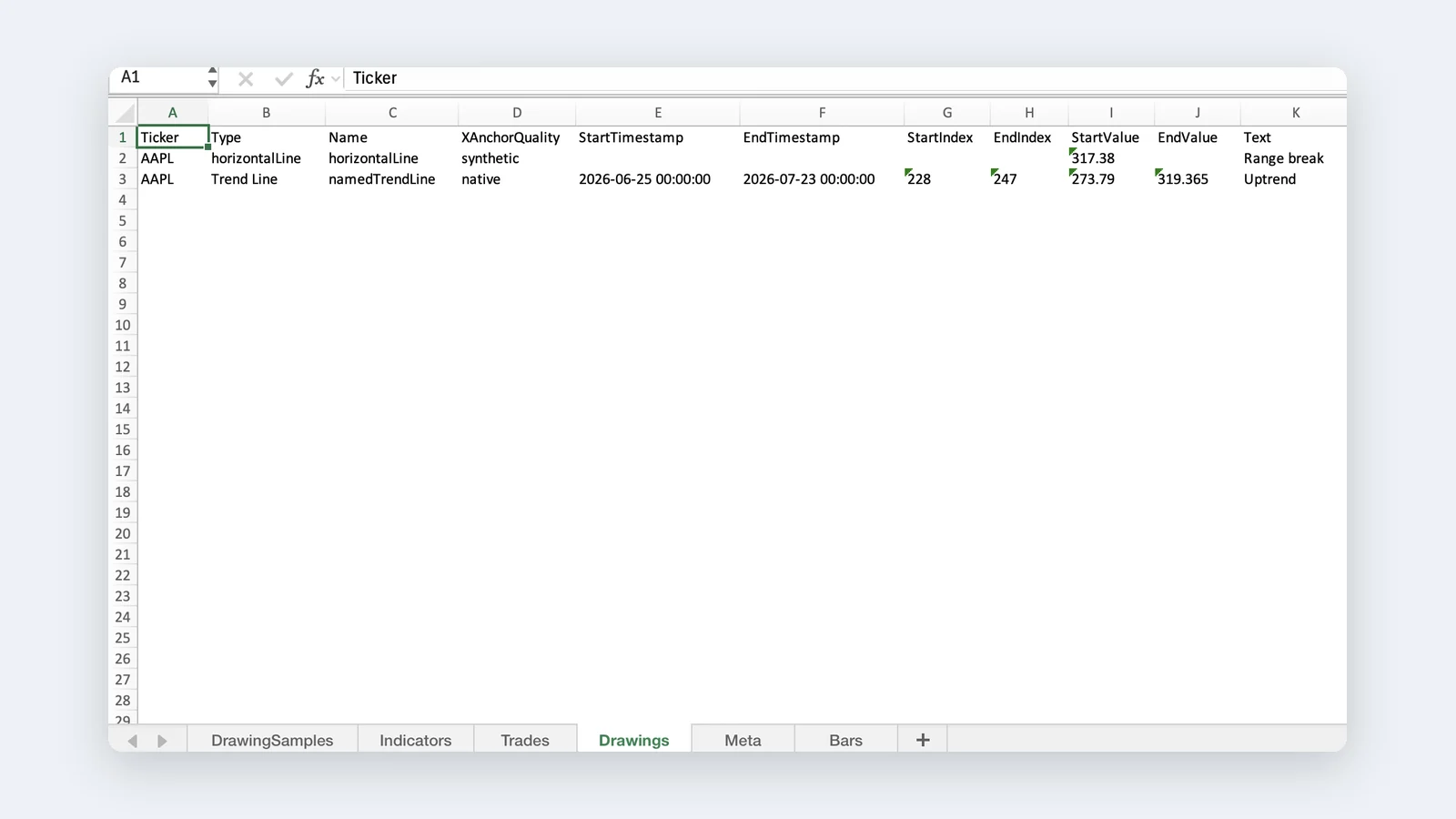
It helps preserve chart notes, drawings, levels, and labels so the screenshot can be supported by structured context.
Sample Structured Chart-Data Exports
Review how chart drawings, annotations, OHLC, volume, and execution context become reusable structured data.