Article
Using Codex or Claude Code With IBKR Chart Data
Use Codex or Claude Code with IBKR chart data through a focused IBKR Codex workflow built around structured exports, prompts, field definitions, and human review.

Codex and Claude Code are useful when the input is specific. For Interactive Brokers (IBKR) chart workflows, that means structured chart context: drawings, notes, levels, symbols, timeframes, review fields, and a narrow task that does not ask the AI to make trading decisions. For searches like codex ibkr or ibkr codex, the practical answer is a controlled handoff from chart data to prompts, schemas, dashboards, documentation, and QA.
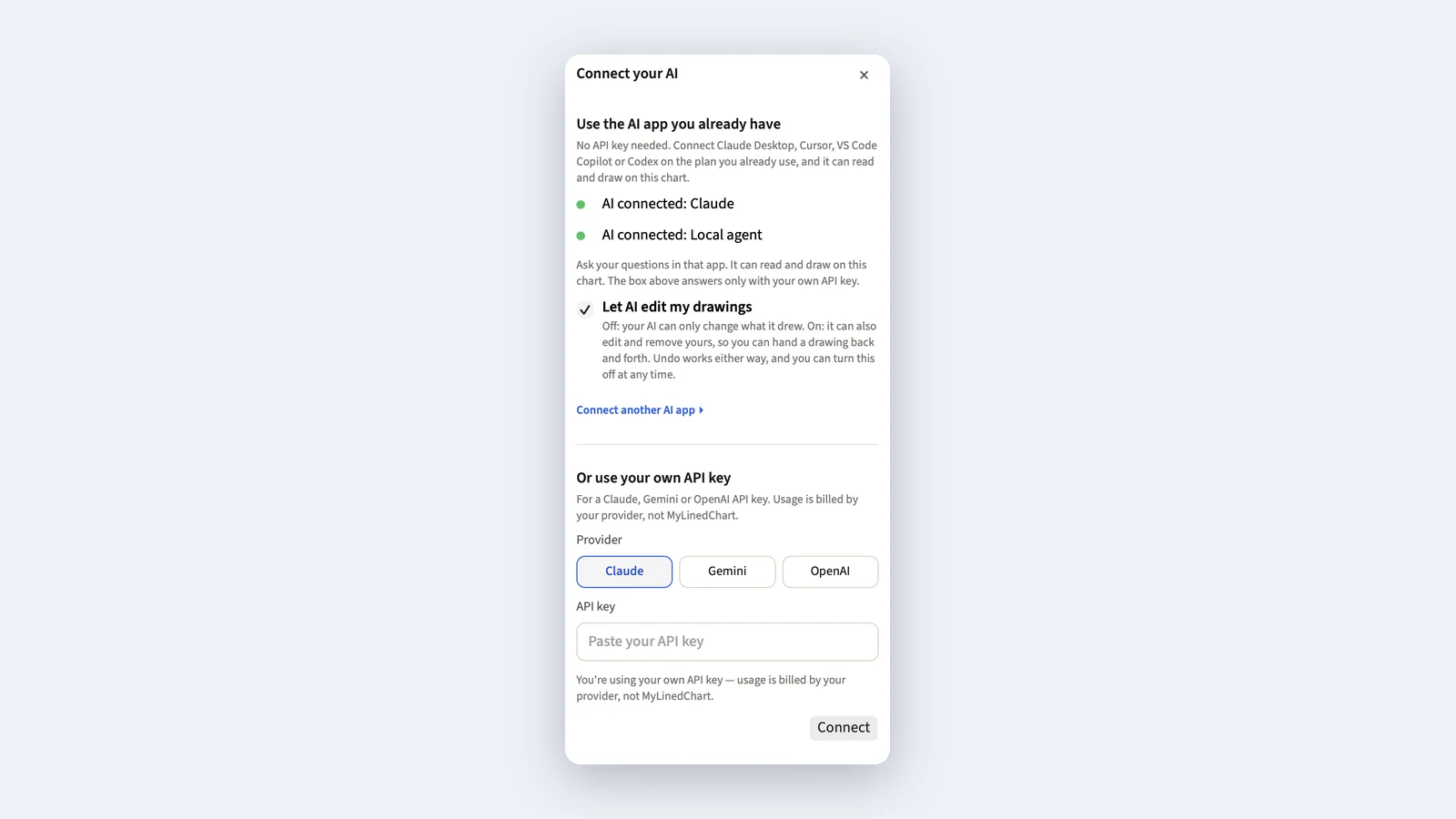
IBKR Codex Workflow: Quick Start
The safest IBKR Codex workflow starts with one structured export and one narrow request. Export the IBKR chart context, define the fields, give Codex or Claude Code a specific implementation task, then review the output before anything enters a live workflow.
Do not start with a screenshot or a broad request to build a trading system. Start with the chart data that AI can inspect: symbol, timeframe, levels, notes, drawings, setup tags, review state, and the output you want.
| Step | What to Provide | Human Control |
|---|---|---|
| Export | Structured IBKR chart context from MyLinedChart | Confirm the data matches the chart |
| Define | Field meanings, labels, and allowed assumptions | Approve the workflow vocabulary |
| Prompt | One task for Codex or Claude Code | Reject unsupported output |
| Review | Parser, table, schema, dashboard draft, or QA checklist | Keep trade decisions outside the AI output |
Prompt for Codex With IBKR Chart Data
Use Codex with IBKR chart data when you want implementation help around exported records. The prompt should name the source, describe the fields, ask for one output, and block unsupported trading advice.
Example prompt: Here is a sanitized MyLinedChart export from my IBKR chart workflow. Explain the fields, identify missing review data, and draft a TypeScript parser that groups notes by setup tag. Do not infer trading advice, do not invent fields, and list every assumption separately.
| Prompt Part | Codex Instruction |
|---|---|
| Context | This is an IBKR chart-data export from MyLinedChart |
| Data | Use only the supplied fields and sample rows |
| Task | Draft a parser, schema, dashboard table, or QA checklist |
| Constraint | No trade recommendations, no risk changes, and no invented market context |
| Review Output | List assumptions, missing fields, and tests a human should run |
Prompt for Claude Code With IBKR Chart Data
Use Claude Code with IBKR chart data when you want a workflow review, documentation pass, or implementation plan around structured exports. Keep the request tied to the supplied records and ask Claude Code to separate facts from recommendations.
Example prompt: Review this MyLinedChart export from my IBKR chart workflow. Summarize the field meanings, draft a journal table schema, flag ambiguous labels, and write a human review checklist. Do not decide whether a trade is valid and do not create a strategy from incomplete data.
| Prompt Part | Claude Code Instruction |
|---|---|
| Context | IBKR chart review data, not a trade signal request |
| Data | Structured notes, drawings, levels, symbols, timeframes, and review fields |
| Task | Summarize, document, find ambiguity, or draft a workflow checklist |
| Constraint | No trading advice, no hidden assumptions, no unreviewed risk logic |
| Review Output | Separate observed fields from recommended fields |
IBKR Chart Data Fields AI Needs
AI tools perform better when the chart context is exported as structured data. That gives the model inspectable fields instead of forcing it to guess from a visual artifact.
For an IBKR Codex workflow, the minimum useful input is price data plus the decision context around the chart and the review rules that keep output human-controlled.
| Input | What It Changes |
|---|---|
| Symbol and timeframe | Keeps the workflow tied to the reviewed market context |
| Drawn levels and zones | Shows where the trader expected decisions to happen |
| Drawing type and anchors | Makes chart geometry inspectable outside the chart |
| Notes and labels | Preserves setup intent and review language |
| Setup tag and review status | Separates active ideas from archived context |
| Export timestamp | Makes comparisons and updates auditable |
| Desired output | Keeps Codex or Claude Code focused on one job |
Human Review Checklist
Before using any AI-generated workflow, review it like production code. The goal is not to be impressed by the output. The goal is to decide whether the output is accurate, narrow, and safe enough to keep improving.
What AI Tools Can Actually Help With
Codex and Claude Code are strongest when the trading problem has been converted into an implementation problem. They can help inspect structure, generate code, organize records, draft documentation, and create QA checklists. They should not replace the trader's judgment.
| Task | Good Use | Human Check |
|---|---|---|
| Parser | Read export files and normalize fields | Verify fields match the actual export |
| Journal table | Turn notes and levels into review rows | Confirm labels match your trading process |
| Dashboard draft | Create metrics and mock tables | Approve definitions before relying on them |
| Schema review | Find missing or ambiguous fields | Decide which fields matter operationally |
| Documentation | Explain the handoff between chart, export, and review | Remove unsupported assumptions |
Where MyLinedChart Fits
MyLinedChart gives Codex and Claude Code a better starting point by turning IBKR chart work into structured context. Drawings, notes, levels, symbols, timeframes, and review fields become data the AI can inspect instead of a screenshot it has to interpret loosely.
That makes the AI workflow more useful and easier to control. The trader still owns the logic, the review, and the final decision, but the implementation work becomes faster to document, test, and connect.
What Not to Ask
Do not ask Codex or Claude Code to decide whether a trade is good. Do not ask it to create a risk plan from incomplete context. Do not let it rewrite your process without a human review step.
The safer pattern is simple: AI drafts the implementation support, the trader approves the workflow logic, and any trading or risk decision remains outside the AI output.
Narrow Support Guides
Use this article as the main IBKR Codex and Claude Code chart-data guide. Use Codex IBKR Chart Data Prompt Template (Copy-Paste) for the Codex prompt template and Using Codex or Claude Code With IBKR Chart Data for the Claude Code review workflow.
Each support guide should feed back into this main page before you expand from one export into a repeatable workflow.
Next Step
Start with one narrow workflow: export IBKR chart notes and levels, ask the AI to explain the fields, then have it draft one parser or journal table. Review the output by hand before expanding the workflow.
Use IBKR Automation & Integration if you need the full IBKR automation map, or workflow consulting if you want help defining the export schema and handoff document.
FAQ
What is an IBKR Codex workflow?
An IBKR Codex workflow is a controlled handoff from structured IBKR chart exports into Codex for implementation support such as parsers, schemas, tables, dashboards, documentation, and QA checks.
Can Codex work with IBKR chart data?
Yes, if the IBKR chart data is structured. Codex works best with exports, field definitions, sample rows, and narrow tasks that a human can review.
Can Claude Code work with IBKR chart data?
Yes. Claude Code can help summarize fields, draft documentation, identify ambiguous labels, and prepare review checklists when the chart data is exported in a consistent structure.
What should I avoid asking AI tools to do?
Avoid asking AI tools to make trading decisions, invent missing context, approve risk changes, or replace human review. Use them for implementation support that a trader can inspect.
What is the first workflow to test?
Start with a sample IBKR chart export and ask for a parser or journal table. Keep the first test small enough that every field and output can be checked manually.
Sample Structured Chart-Data Exports
Review how chart drawings, annotations, OHLC, volume, and execution context become reusable structured data.